If creating content feels overwhelming, the problem usually isn’t a lack of ideas.
It’s the assumption that every post needs to be brand new.
One of the biggest mindsets shifts in modern marketing is understanding that strong content strategies are not built on constant creativity. They are built on systems that multiply ideas.
"Crystal Lau is a marketing consultant and content creator based in Kelowna, BC, and the founder of Lau Method Marketing. She documents Okanagan tourism, local hidden gems, and real-world marketing strategy on her Instagram @laucrystalmomo, where she has built a community of 17k+ followers across Canada."
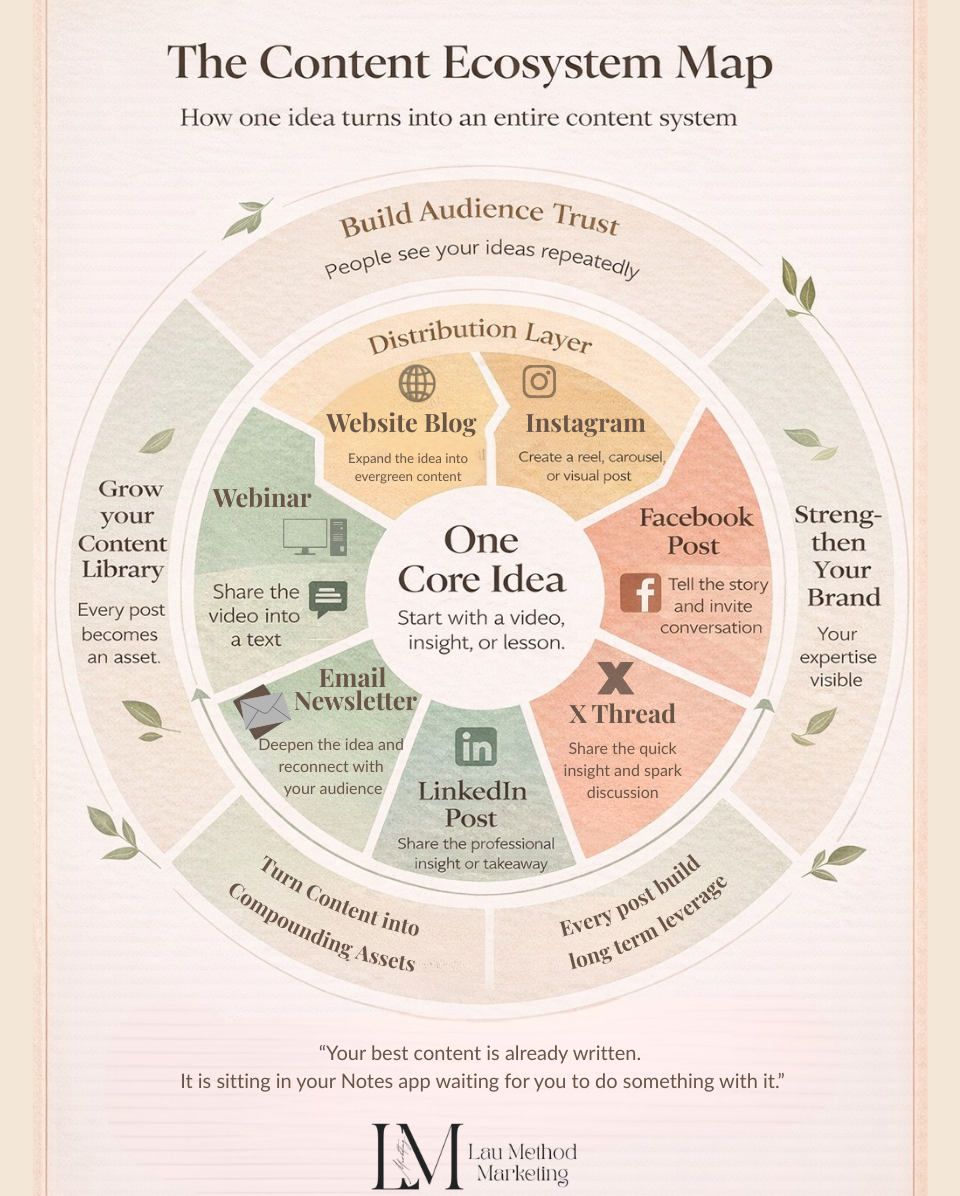
At Lau Method, we often describe this as a content ecosystem.
Instead of thinking in terms of individual posts, we think in terms of one core idea that expands into an entire network of content.
When done well, a single insight can generate dozens of valuable pieces of content across different platforms.
The goal is not to work harder.
The goal is to make every idea travel further.
Start With One Core Idea
Every ecosystem begins with a central idea.
This might come from a client insight, a lesson learned in your work, a question your audience often asks, or an observation from your industry.
The important thing is that the idea is useful and meaningful, not just trendy.
Examples of core ideas might include:
A lesson learned from working with a client
A new perspective on a common marketing problem
A strategy that helped your business grow
A mistake that taught you something valuable
This core idea becomes the center of your content system.
From there, the goal is not to repeat it word for word.
Instead, the goal is to translate the idea into different formats that serve different audiences.
Build Your Distribution Layer
Once you have the core idea, the next step is distribution.
Different platforms allow the same idea to be shared in different ways.
For example:
A short video explaining the insight
A written post that expands on the lesson
A carousel that breaks the idea into steps
A story that shares the behind-the-scenes experience
Each version helps people understand the same concept in a new way.
This is where many creators make a mistake.
They believe reposting or repurposing means copying content.
In reality, repurposing means reframing the same insight for different contexts.
One idea can become:
LinkedIn insights
Instagram reels or carousels
Facebook storytelling posts
Blog articles
Email newsletters
The message stays consistent.
The delivery changes.
Turn Content Into a Growing Library
When content is created this way, something powerful starts to happen.
Your posts stop being temporary.
They start becoming assets.
Every idea you share contributes to a growing content library that people can discover over time.
Someone might find you through:
A post shared months ago
A blog article you wrote last year
A video someone reposted
A conversation sparked in a comment section
Instead of constantly chasing attention, your content begins to work for you in the background.
Over time, this creates a body of work that reflects your thinking.
And that body of work builds credibility.
The Real Outcome: Trust and Visibility
The goal of a content ecosystem is not just reach.
It is trust.
When people encounter your ideas repeatedly in different formats, they begin to understand how you think.
That familiarity builds confidence in your perspective.
Your audience starts to associate you with certain insights, frameworks, or approaches.
Your expertise becomes visible.
And as that visibility grows, so do opportunities.
Opportunities to collaborate
Opportunities to teach
Opportunities to work with aligned clients
Opportunities to grow your business
Not because you posted more often.
But because your ideas were able to travel further.
A Simpler Way to Think About Content
Instead of asking:
“What should I post today?”
Try asking a different question.
“What idea am I exploring right now?”
That single shift can transform how you approach content creation.
Because one strong idea does not need to live in just one post.
It can become an entire ecosystem.
And over time, those ecosystems become the foundation of a meaningful and sustainable content strategy.
Lau Method
One idea can power your entire content ecosystem.
